
If you have oily, acne-prone skin, you already know the routine: blotting papers by lunchtime, a shine that returns an hour after washing, and pores that look larger every year. Singapore’s heat and humidity make it worse. Topical treatments help, but some people reach a point where their skin is under control yet still produces far more oil than they would like.
That is where micro-Botox comes in. Also called microtox, mesobotox or the “Botox facial”, it uses the same botulinum toxin as anti-wrinkle injections, but delivered in a very different way and for a very different purpose. This guide covers how it works, what the evidence actually shows for oily and acne-prone skin, where it fits alongside standard acne treatment, and what to ask before booking.
What Is Micro-Botox?
Standard anti-wrinkle injections place botulinum toxin into specific facial muscles (the frown lines, forehead or crow’s feet) to relax them and soften expression lines. Micro-Botox works at a much shallower level. The doctor dilutes the toxin and places dozens of tiny droplets just under the skin surface, in the dermis, spread evenly across the treatment area.
At that depth, the toxin has little effect on the large muscles that create expressions. Instead, it acts on the skin itself: the sebaceous (oil) glands, the sweat glands and the tiny muscles attached to hair follicles. The result is skin that produces less oil and looks smoother and tighter in texture, without the “frozen” look associated with conventional injections.
How Micro-Botox Reduces Oil and Pore Size
Sebaceous glands are influenced by acetylcholine, the same nerve signalling chemical that botulinum toxin blocks in muscles. Researchers believe that when the toxin is placed in the dermis, it dampens this signalling to the oil glands, so they produce less sebum. It also relaxes the arrector pili muscles around each follicle, which may be why pores often look smaller after treatment.
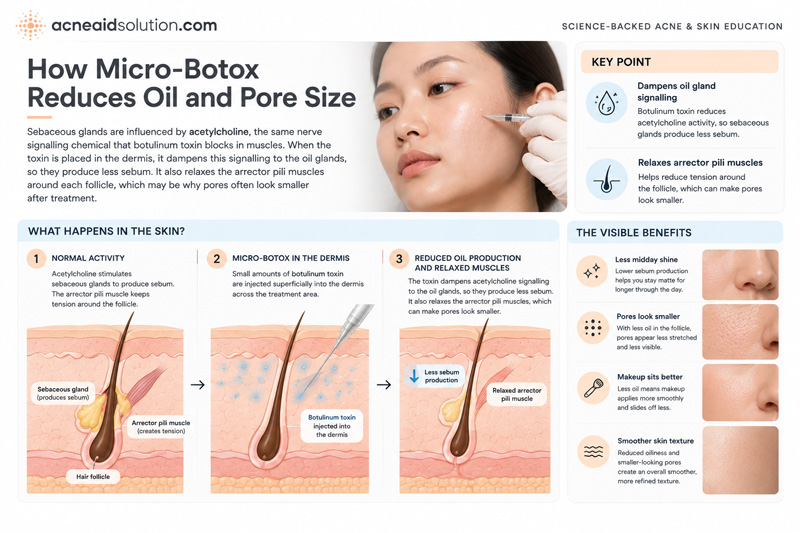
Less sebum on the surface means:
- Less midday shine and a more matte finish that lasts longer through the day
- Pores that look less stretched, since excess oil sitting in the follicle tends to make pores look larger
- Makeup that sits better and slides off less
- A smoother overall skin texture
Can Micro-Botox Treat Acne?
This is the most important point to understand: micro-Botox is not an acne treatment in the way that retinoids, benzoyl peroxide, antibiotics or isotretinoin are. Acne develops from a combination of excess oil, clogged follicles, C. acnes bacteria and inflammation (see our guide to the causes of acne). Micro-Botox addresses only the first of these.
Because excess sebum is one of the drivers of breakouts, some doctors use micro-Botox as an add-on for patients whose acne is largely controlled but who still struggle with very oily skin. Early research suggests it may reduce breakouts in some people, but there is not yet enough evidence to recommend it as a standalone treatment for active acne.
If you have active inflammatory acne, painful cysts or new scarring, start with proven medical treatment first. Our overview of acne treatments in Singapore and our guide to isotretinoin (Accutane) are good places to begin. Isotretinoin, for example, shrinks the oil glands far more dramatically than micro-Botox can.
Who Is Micro-Botox Suitable For?
Micro-Botox tends to suit people who:
- Have persistently oily skin, especially across the T-zone, that does not respond well to skincare alone
- Have enlarged pores driven by excess oil rather than by sun damage or loss of elasticity
- Have acne that is mostly under control but who want to reduce oiliness and the occasional breakout
- Have facial flushing or redness. Doctors also use intradermal toxin for this, and you can read more about botulinum toxin for rosacea and skin redness
It is generally not recommended during pregnancy or breastfeeding, for people with neuromuscular conditions such as myasthenia gravis, or where there is active infection in the treatment area. Your doctor will review your medical history and medications before treating.
Micro-Botox vs Standard Botox
| Micro-Botox | Standard anti-wrinkle Botox | |
|---|---|---|
| Injection depth | Superficial (dermis) | Into specific muscles |
| Number of injection points | Many tiny droplets across the area | A few targeted points |
| Main purpose | Oil control, pores, texture, redness | Relaxing expression lines |
| Effect on facial expression | Minimal when done correctly | Softens movement in the treated muscles |
| Typical duration | About 3 to 4 months | About 3 to 4 months |
What to Expect During Treatment
A session usually takes 20 to 30 minutes. The doctor cleanses the skin and often applies numbing cream first. The diluted toxin is then injected as a grid of very small, shallow injections across the target area, commonly the forehead, nose and cheeks for oily skin. Some clinics use a fine needle by hand, while others use an injector device to place the droplets evenly.
You may see small bumps at the injection points that settle within an hour or so, plus mild redness. Most people return to work the same day. Oil reduction typically becomes noticeable within one to two weeks, and results generally last around three to four months, after which the treatment can be repeated.
Side Effects and Risks
When performed by an experienced doctor, micro-Botox is generally well tolerated. Common effects include:
- Temporary redness, small bumps and pinpoint bruising at the injection sites
- Mild tenderness for a day or two
The main technique-related risk is the toxin spreading to nearby muscles. Around the mouth and lower cheeks this can cause a temporarily uneven smile or weakness that lasts until the product wears off. Dose, dilution and depth matter a great deal, which is why the treating doctor’s experience is so important. Good practitioners aim for a natural-looking botulinum toxin result, with oil control but no change in how your face moves.
How Micro-Botox Fits With Other Treatments
Micro-Botox is often combined with other treatments rather than used alone:
- Medical acne treatment: topical or oral therapies to treat active acne, with micro-Botox added later for residual oiliness.
- Lasers for pores and texture: pico laser or RF microneedling can improve pore size and texture through collagen remodelling, which complements the oil reduction from micro-Botox.
- Acne scar treatment: micro-Botox does not treat existing scars. For pitted or rolling scars, see our guide to which acne scar treatment suits your scar type.
Your doctor will advise on sequencing, as some treatments need to be spaced apart.
How to Choose a Doctor for Micro-Botox in Singapore
Look for a doctor-led clinic that offers both standard and micro-Botox, explains the dilution and areas to be treated, and gives clear per-session pricing upfront. Ask how many sessions they typically see results with, how they avoid the smile muscles, and what follow-up they provide. A good starting point is a GP or aesthetic clinic that provides doctor-administered Botox in Singapore with a proper consultation before treatment. Our guide to choosing the best aesthetic doctor for acne treatment covers what else to look for.
Frequently Asked Questions
How long does micro-Botox last for oily skin?
Most people find the oil-reducing effect lasts about three to four months. Some notice it lasting a little longer after repeated sessions, but maintenance treatments are needed to keep the results.
Will micro-Botox make my face look frozen?
It should not. Because the toxin is placed superficially in the skin rather than into the muscles, facial expressions are normally unaffected. Unwanted muscle weakness is a sign that the toxin has spread deeper or wider than intended, which careful technique avoids.
Can micro-Botox shrink pores permanently?
No. It can make pores look smaller for as long as the effect lasts, mainly by reducing the oil that stretches them. For longer-lasting pore improvement, treatments that build collagen, such as lasers or RF microneedling, are usually combined with it.
Is micro-Botox safe for acne-prone skin?
Generally yes, when performed by a doctor on skin without active infection in the treatment area. If you have a significant active breakout, your doctor may advise treating that first.
Can I get micro-Botox while on isotretinoin?
Discuss this with your doctor. Isotretinoin already reduces oil production substantially, so micro-Botox is usually considered after a course ends, when oiliness starts to return.