
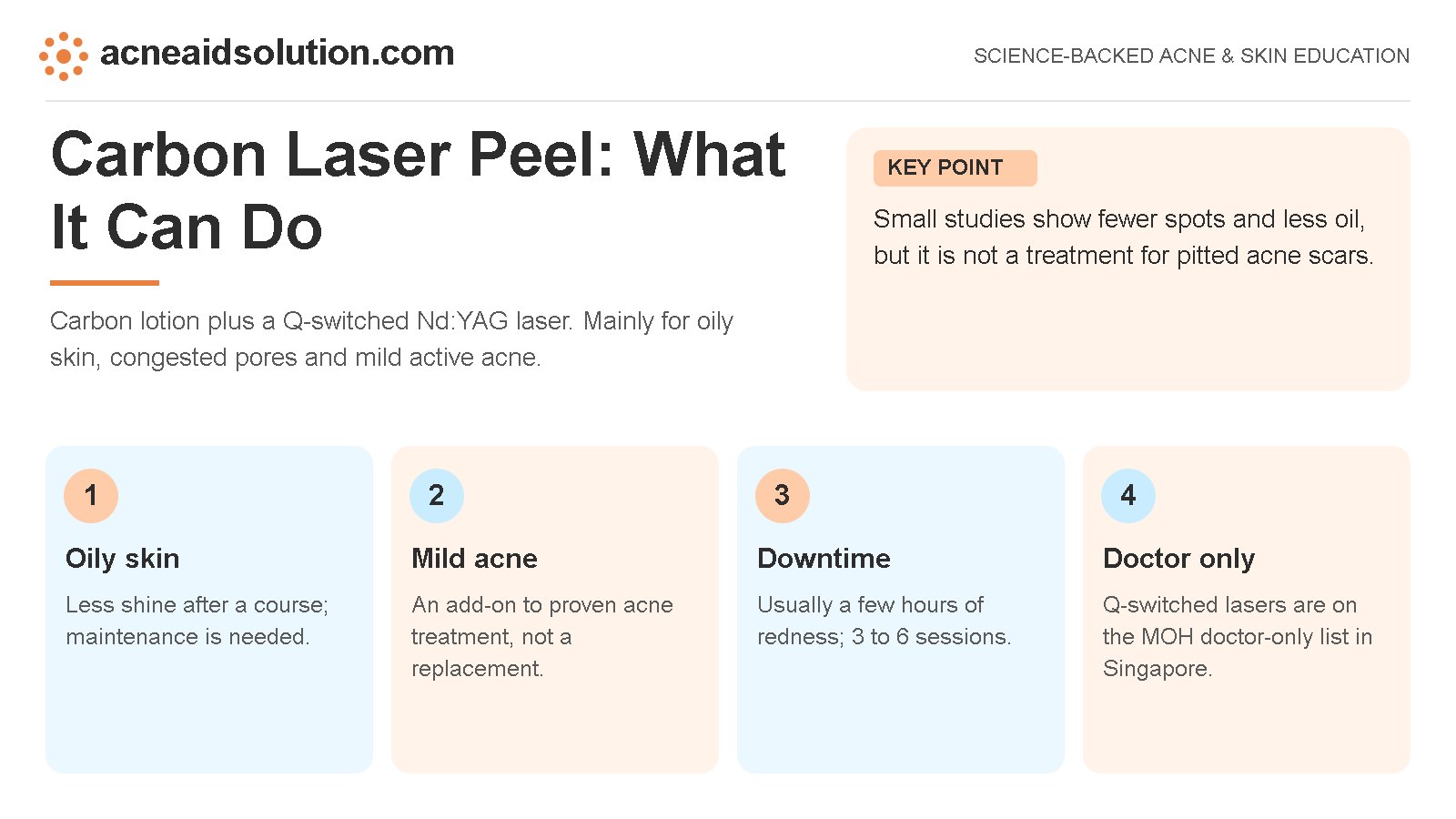
A carbon laser peel is a doctor-performed treatment in which a thin layer of carbon lotion is painted on the face and then heated off with a Q-switched Nd:YAG laser. In Singapore it is mainly offered for oily skin, enlarged-looking pores and mild active acne, with little or no downtime. Small studies suggest it can reduce spots and oiliness over a course of sessions, but the evidence is limited and it is not a treatment for acne scars.
Key takeaways
- Carbon laser peel combines a carbon lotion with a Q-switched 1064 nm Nd:YAG laser; it is a laser toning treatment, not a chemical peel.
- Small studies show fewer spots and less oiliness after several sessions, but there are no large trials, and results fade without maintenance.
- It does very little for pitted (atrophic) acne scars; scar treatments such as fractional lasers or subcision work at a deeper level.
- Side effects are usually mild redness for a few hours; pigment changes are possible, especially in darker or tanned skin.
- In Singapore, Q-switched lasers must be performed by a doctor, not a beauty salon.
What Is a Carbon Laser Peel?
A carbon laser peel (also called a carbon peel, laser carbon facial or “Hollywood peel”) uses a black carbon suspension as a target for a Q-switched Nd:YAG laser at 1064 nm.
A typical session runs like this:
- The face is cleansed and a liquid carbon lotion is applied, avoiding the eyelids, brows and lips.
- The carbon is left for around 10 minutes to settle into the surface and pore openings, and any excess is wiped off.
- The doctor passes the laser over the face. You will hear a snapping sound and feel warmth or light prickling as the carbon is vaporised.
- Some clinics do a second, lower-energy laser pass on bare skin afterwards.
Researchers think it works through a mild peeling effect, heat reaching the sebaceous (oil) glands, and an effect on Cutibacterium acnes, the bacteria involved in acne. These mechanisms are still unproven.
Can a Carbon Laser Peel Treat Acne?
It can help mild to moderate active acne in some people, but it should be seen as an add-on to proper acne treatment rather than a replacement for it.
The best-known study is a 2012 split-face trial of 22 people with acne. After three sessions two weeks apart, inflammatory spots on the treated side fell by about 59% and blackheads and whiteheads by about 52%, while the untreated side did not improve. Sebum output also dropped. Later reports, including a 2022 retrospective study from Italy, also reported improvement, but these were small and uncontrolled.
A 2026 expert review of non-ablative lasers for acne concluded that the limited evidence looks promising, but that varied protocols and small, mostly single-centre studies do not yet confirm lasers as an alternative to standard treatment. The American Academy of Dermatology says lasers and lights rarely clear acne on their own and that most people need a series of treatments, often with a topical medicine alongside.
For deep, painful nodules or cysts, carbon peel is not the right first step. See our guide to treating cystic acne in Singapore and our overview of acne treatments available in Singapore.
Oily Skin, Pores, Dark Marks and Acne Scars: What It Can and Cannot Do
Carbon peel is best suited to oily, congested skin with mild acne. Its effect on dark marks is modest, and it is not a scar treatment.
- Oiliness: studies report reduced sebum after a course of sessions. The effect is temporary, so maintenance is usually needed.
- Pores: pores may look smaller and skin smoother. The evidence relies mostly on photographs, and pore size is partly genetic.
- Post-inflammatory hyperpigmentation (PIH): the flat brown marks left after spots. Low-energy Q-switched Nd:YAG toning is used for pigment, and a gradual brightening effect is possible. The risk is that laser heat can also trigger new pigmentation in darker skin, so settings need care.
- Atrophic acne scars: ice pick, boxcar and rolling scars are textural changes in the deeper skin. Carbon peel works at the surface and has no good evidence for these.
If your main concern is scarring, read our guides to the different types of acne scars and the scar treatments that suit each type.
How Many Sessions Do You Need, and Is There Downtime?
Most people are advised to have a course of three to six sessions, spaced two to four weeks apart, with little or no downtime.
Published protocols vary from three sessions two weeks apart to monthly sessions. Expect:
- Mild redness or a pinkish flush for a few hours, occasionally until the next day.
- Most people return to work the same day and can wear makeup the next day if the skin is calm.
Aftercare matters. Use a gentle cleanser and moisturiser, avoid scrubs and strong acids for a few days, and wear a broad-spectrum sunscreen every day. This matters under Singapore’s strong year-round UV.
Carbon Laser Side Effects
Side effects are usually mild and short-lived, but pigment changes and, rarely, burns can occur.
- Common: redness, warmth, mild swelling and a prickling sensation during treatment.
- Less common: dryness, a temporary flare of spots, small areas of crusting.
- Pigment changes: darker patches (hyperpigmentation) or, less often, lighter patches (hypopigmentation). DermNet advises extra caution with Nd:YAG lasers in tanned or darker skin.
- Rare: blistering, burns, infection or scarring, usually linked to unsuitable settings or poor aftercare.
Who Should Not Have a Carbon Laser Peel?
Carbon peel is not suitable for everyone. Tell the doctor about your skin history and medications before booking.
- Very inflamed, cystic or severe acne: this needs medical treatment first.
- Recent tanning or sunburn: laser energy is more likely to cause pigment problems.
- A history of melasma or easily triggered pigmentation: heat can worsen it in some people.
- Active skin infection such as cold sores or impetigo on the face.
- Isotretinoin, now or recently: tell the doctor, as some prefer to wait or adjust the treatment.
- Pregnancy or breastfeeding: there is no safety data, and most doctors defer elective laser treatment. Acne medicines such as isotretinoin, oral and topical retinoids and spironolactone must not be used in pregnancy, so discuss any acne plan with your doctor if you are pregnant or trying to conceive.
- Keloid scarring or light-sensitive conditions.
Carbon Peel vs Chemical Peel vs Pico Laser
These three work differently and suit different problems.
| Carbon laser peel | Chemical peel | Pico laser | |
|---|---|---|---|
| How it works | Q-switched Nd:YAG laser heats and removes a carbon layer | An acid (e.g. salicylic or glycolic) loosens surface cells | Picosecond laser pulses break up pigment; fractional handpieces target texture |
| Best for | Oily skin, congested pores, mild active acne | Blackheads, whiteheads, mild acne, dullness, mild dark marks | Dark marks and pigmentation; mild textural scarring with fractional mode |
| Acne scars | Little or no effect | Light peels: minimal; deeper peels: some help for shallow scars | Modest help for shallow scars (fractional) |
| Typical downtime | A few hours of redness | None to several days of flaking, depending on strength | Usually a day or two of redness |
| Main risk | Pigment changes in darker or tanned skin | Irritation, pigment changes with stronger peels | Pigment changes; temporary redness |
| Evidence for acne | Small studies | Reasonable for mild acne as an add-on | Mainly studied for pigment and scars |
If dark marks or pigmentation are your main concern rather than oil, see our pico laser guide.
Carbon Laser in Singapore: Who Can Do It and What It Costs
In Singapore, carbon laser peels should only be done by a doctor in a licensed clinic. Q-switched Nd:YAG lasers are pigment lasers, which are on the Ministry of Health list of aesthetic procedures non-doctors cannot perform, and the National Environment Agency restricts Class 4 lasers on the body to registered medical practitioners, not salons or spas.
Carbon peel is a cosmetic treatment, so it is not subsidised at public clinics and is generally not claimable from MediSave or MediShield Life. Published prices vary widely. As examples, Become Aesthetics lists carbon laser peel from $450 (GST not stated), and V Aesthetics lists a price of $48 nett (both checked 23 November 2026). Very low headline prices are often first-trial offers, so ask what is included, whether consultation and GST are extra, and how many sessions are recommended. For a broader comparison, see our guide to acne and scar treatment costs in Singapore.
When to See a Doctor
See a GP or dermatologist rather than booking a laser if:
- You have painful lumps, cysts or nodules, or your acne is leaving scars.
- Over-the-counter products have not helped after two to three months.
- You develop blistering, crusting, spreading redness or new dark patches after a laser treatment.
In Singapore, a polyclinic or GP can start treatment and refer you to the National Skin Centre if needed. Some acne medicines are prescription-only, so ask a pharmacist or doctor which options suit you.
Frequently Asked Questions
Is carbon laser peel good for acne?
It can reduce mild to moderate spots and oiliness over several sessions, based on small studies. It works best alongside standard acne treatment and is not a stand-alone cure.
Does carbon laser peel remove acne scars?
No, not meaningfully. It may brighten flat dark marks over time, but pitted scars need treatments that reach deeper, such as fractional lasers, subcision or microneedling.
How long do carbon laser results last?
Reduced oiliness and smoother skin usually last weeks to a few months. Many people need maintenance sessions, and results depend on keeping acne under control with daily skincare or medication.
Is carbon laser safe for Asian skin?
It is commonly used on Asian skin, but darker skin tones have a higher risk of pigment changes. Choose an experienced doctor, avoid tanning before and after, and use sunscreen daily.
Can I do carbon laser at a salon in Singapore?
No. Q-switched lasers are on the MOH list of procedures that must be performed by doctors, so carbon laser peels should only be done at a medical clinic.
Sources
- American Academy of Dermatology: Lasers and lights: How well do they treat acne? (2026)
- DermNet: Neodymium YAG laser treatment (2023, updated 2024)
- PubMed: Jung JY et al. Prospective randomized controlled clinical and histopathological study of acne vulgaris treated with Q-switched 1064-nm Nd:YAG laser assisted with a topically applied carbon suspension. J Am Acad Dermatol (2012)
- PMC: Conforti C et al. Carbon Peeling Laser Treatment to Improve Skin Texture, Pores and Acne Lesions: A Retrospective Study. Medicina (2022)
- PMC: Guida S et al. Carbon Peel Laser Technique to Improve Skin Quality: Back to Science! Dermatol Pract Concept (2020)
- PMC: Ballanger F et al. A Critical Narrative Review and Expert Consensus on the Clinical Positioning of Non-Ablative Laser-Based Therapy in Acne Treatment. J Cosmet Dermatol (2026)