
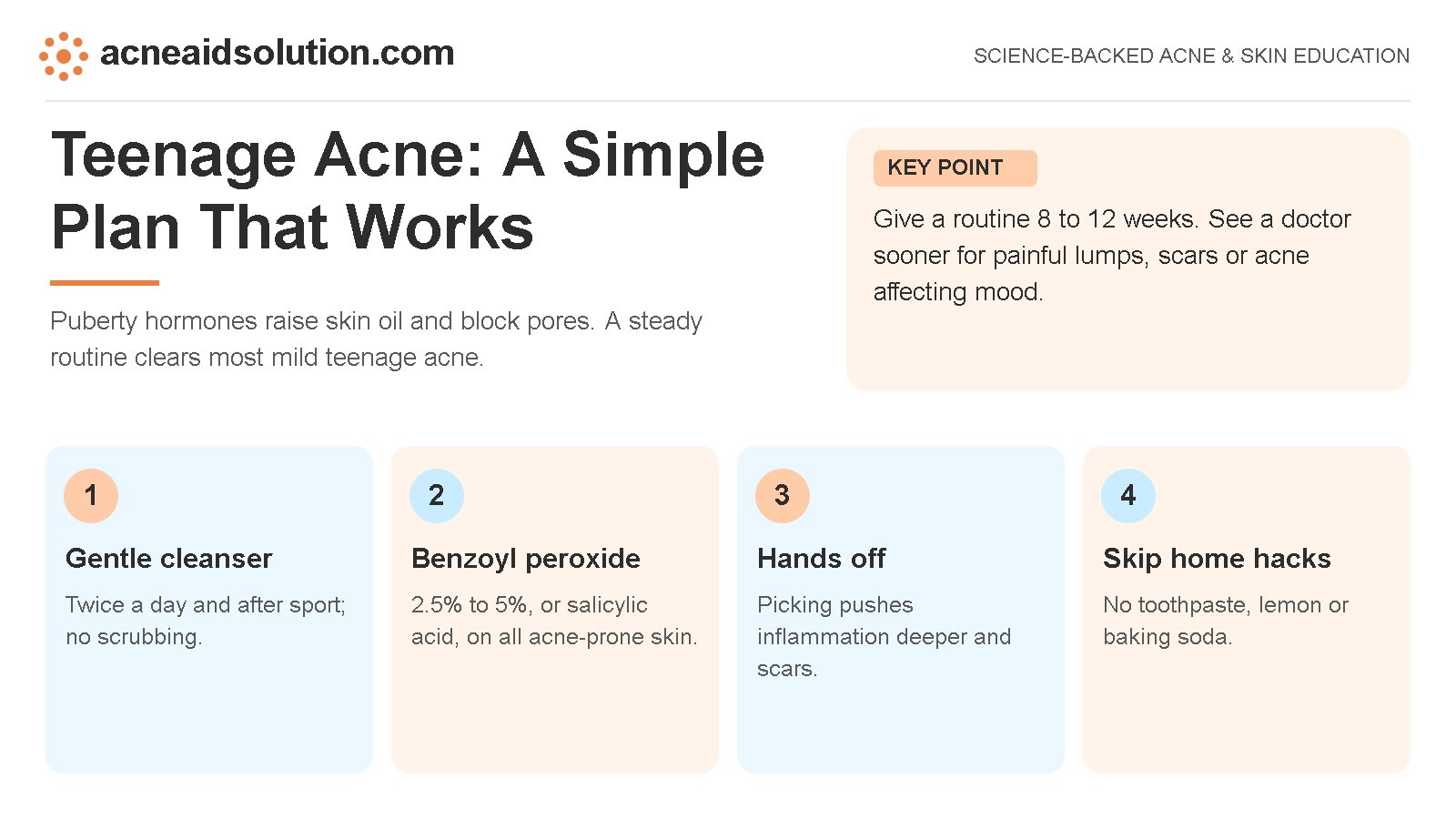
The best way to get rid of teenage pimples is a simple, consistent routine: wash twice a day with a gentle cleanser, use a pharmacy treatment such as benzoyl peroxide or salicylic acid on all acne-prone skin, add a light non-comedogenic moisturiser and sunscreen, and stop picking. Most mild teenage acne improves within 6 to 8 weeks of steady use. If spots are deep, painful, scarring or affecting how a teen feels about themselves, see a doctor rather than waiting it out.
Key takeaways
- Teenage acne is driven by puberty hormones that increase skin oil, which mixes with dead skin cells and blocks pores.
- A basic routine of gentle cleanser, benzoyl peroxide or salicylic acid, moisturiser and sunscreen works better than frequent product switching.
- Tea tree oil 5% gel has some trial evidence; toothpaste, lemon juice and baking soda irritate skin and should be skipped.
- Give any treatment 8 to 12 weeks before judging it, but ask a pharmacist or doctor sooner if nothing has changed after 4 to 6 weeks.
- In Singapore, start with a pharmacist or GP; a polyclinic can refer to the National Skin Centre for subsidised specialist care.
Why Teenagers Get Acne
Teenagers get acne mainly because puberty hormones make the skin produce more oil. HealthHub lists the rise in testosterone during puberty as a leading cause, and this happens in both boys and girls.
Extra oil (sebum) mixes with dead skin cells and blocks pores, forming blackheads and whiteheads. When bacteria multiply and the skin reacts, these become red or pus-filled spots, and sometimes deeper, painful nodules or cysts. Acne usually shows on the forehead, nose and chin, and can spread to the chest and back. It is not caused by being dirty.
In Singapore, heat and humidity add to the problem: skin stays sweaty for longer, and uniforms, CCA kit and helmets trap that sweat against the skin.
A Simple Home Routine That Works
A short, consistent routine is the most effective home treatment for pimples on a teenage face. A few proven products used daily beat trying something new every week.
- Gentle cleanser, twice a day. Wash morning, night and after sport with fingertips and lukewarm water. Scrubbing or over-washing makes acne worse.
- Benzoyl peroxide (2.5% to 5%). Reduces acne bacteria and inflammation; lower strengths are less drying. It bleaches fabric, so watch towels and uniforms.
- Salicylic acid (often 0.5% to 2%). Helps unblock pores; suits mainly blackheads and whiteheads.
- Non-comedogenic moisturiser. Acne products dry the skin; a light, oil-free moisturiser helps teens stick with treatment.
- Sunscreen every morning. Choose one labelled non-comedogenic or oil-free. Sun protection also helps red and brown marks left by spots fade.
Apply treatment as a thin layer over the whole area where spots appear, not just on individual pimples, to prevent new ones. Start with one active product and add a second only if your skin copes.
Natural Remedies: What Has Evidence and What to Avoid
Few natural remedies for teenage acne have good evidence. Tea tree oil is the main exception, and several popular home hacks do more harm than good.
In a randomised, double-blind trial of 60 people with mild to moderate acne, a 5% tea tree oil gel reduced spots more than a placebo gel over 45 days. Use a ready-made product at around this strength, never undiluted oil, and patch test first because it can irritate.
| Home remedy | Verdict | Why |
|---|---|---|
| Tea tree oil 5% gel | Reasonable to try | Small trial evidence for mild to moderate acne; patch test first |
| Toothpaste | Avoid | Made for teeth, not skin; flavourings and other ingredients can irritate and burn |
| Lemon or lime juice | Avoid | Acidic and irritating; lime juice on skin in sunlight can cause blistering and long-lasting dark marks |
| Baking soda | Avoid | Alkaline, can disrupt the skin barrier and causes dryness and irritation |
| Rubbing alcohol | Avoid | Dries and irritates skin, which can worsen acne |
For a wider look at kitchen-cupboard options, see our guide to home remedies for acne and which ones to skip.
Everyday Habits That Make a Difference
Small daily habits can reduce breakouts, especially in Singapore’s climate. They support treatment but won’t clear acne alone.
- Don’t pick or squeeze. Popping pushes material deeper, increases inflammation and raises the risk of scarring.
- Watch hair products. Gels, waxes, pomades and oils can block pores along the forehead and hairline. Wash hair regularly and tie long hair back. Our guide to hairline acne and hair products covers this in detail.
- Sports gear and helmets. Friction and trapped sweat from helmets, headbands, straps and masks trigger breakouts. Wash soon after sport and clean straps and liners regularly.
- Phone and pillowcase. Evidence is limited, but wiping your phone screen and changing pillowcases a couple of times a week is an easy, low-cost step.
- Remove make-up before bed and choose non-comedogenic make-up and skincare. Don’t share brushes.
- Sleep and stress. HealthHub recommends regular sleep of 7 to 8 hours and managing stress, both of which can be hard during exam periods.
More day-to-day steps are in our guide on how to prevent acne.
Does Diet Affect Teenage Acne?
Diet may play a small role for some teens, but the evidence is limited and no food causes acne on its own. Cutting out whole food groups is not necessary.
The American Academy of Dermatology says small studies suggest a low-glycaemic diet, with fewer sugary drinks, white bread and fried snacks, may reduce acne. Some studies link cow’s milk with acne, but these show an association, not proof, and yoghurt and cheese have not been linked. HealthHub says foods high in sugar may worsen acne.
A sensible step is to cut back on bubble tea and other sugary drinks and see whether skin changes over a couple of months. Growing teens should not drop dairy without replacing the calcium.
How Long Until Teenage Acne Improves?
Give a routine 8 to 12 weeks of daily use before deciding it doesn’t work. Improvement is often visible at 6 to 8 weeks, and complete clearing can take 3 to 4 months.
Switching products every week is a common reason acne doesn’t clear. That said, HealthHub advises seeing a doctor if there is no improvement after 4 to 6 weeks of pharmacist-recommended products. Once skin clears, keep up the routine to stop acne returning.
Mild, Moderate or Severe: What to Do
What to do depends on severity. Use this as a rough guide; a doctor can grade acne properly.
| Severity | What it looks like | What to do |
|---|---|---|
| Mild | Mostly blackheads and whiteheads, a few small red spots | Home routine with benzoyl peroxide or salicylic acid; ask a pharmacist; review at 8 to 12 weeks |
| Moderate | Many red spots and pus-filled spots, possibly on chest or back | See a pharmacist or GP; prescription creams or tablets may be needed |
| Severe | Painful nodules or cysts, scarring, or acne affecting mood | See a doctor promptly; ask about referral to a dermatologist or the National Skin Centre |
Teenage Acne Treatment in Singapore
In Singapore, start with a pharmacist, move to a GP or polyclinic if needed, and get referred to the National Skin Centre (NSC) for specialist care.
- Pharmacist: benzoyl peroxide, salicylic acid and sulphur products are sold over the counter, and a pharmacist can advise on stronger options.
- GP or polyclinic: a doctor can prescribe topical or oral treatments and decide whether specialist care is needed.
- National Skin Centre: subsidised appointments for eligible Singapore citizens and PRs need a referral from a polyclinic, a CHAS GP (for CHAS cardholders) or a subsidised public clinic, and the referring clinic books the first appointment (NSC). A subsidised first visit costs about $30.30 to $70.70 for citizens (NSC, checked 17 Nov 2026).
Facials can help with blackheads but don’t replace treatment; see how acne facials work for teen acne. For costs and options, see acne treatments in Singapore.
Prescription options in brief
- Topical retinoids such as adapalene: unblock pores. In Singapore, some adapalene products are supplied by pharmacists and others need a prescription, so ask a pharmacist or doctor depending on the product. Avoid retinoids during pregnancy.
- Antibiotics: topical (such as clindamycin) or oral (such as doxycycline) for inflamed acne, usually combined with benzoyl peroxide to reduce bacterial resistance.
- Isotretinoin: a prescription-only tablet for severe or scarring acne, usually from a skin specialist. It can seriously harm an unborn baby, so it must never be taken in pregnancy and effective contraception is needed before, during and after treatment. Doctors also monitor mood.
When to See a Doctor
See a doctor if home treatment isn’t helping, or promptly if acne is deep, painful, scarring or affecting mental health. Early treatment can prevent permanent scars.
- Painful lumps under the skin (nodules or cysts)
- Spots leaving scars, dents or dark marks
- No improvement after 4 to 6 weeks of pharmacist-recommended products, or little progress by 12 weeks
- Signs of infection, such as hot, swollen, red skin
- Acne affecting confidence, mood, school or social life
Acne can contribute to anxiety, low self-esteem and depression, so parents should take it seriously rather than saying it will pass. Watch for sadness lasting two weeks or more, or a teen avoiding friends. Our guide on coping when acne knocks your confidence has practical support for teens and parents.
Frequently Asked Questions
How can I get rid of teenage pimples naturally at home?
Wash gently twice a day, stop picking and keep hair products off your face. A 5% tea tree oil gel has some trial evidence, but a pharmacy benzoyl peroxide or salicylic acid product is more reliable.
What is the best acne treatment for a teenager?
For mild acne, benzoyl peroxide 2.5% to 5% is a good starting point, often with a salicylic acid cleanser. Moderate or severe acne usually needs a doctor, who may prescribe a retinoid, antibiotics or isotretinoin.
At what age does teenage acne stop?
There is no fixed age. It often settles by the early twenties but can continue into adulthood, so treating it early is better than waiting.
Can I pop my pimples if I’m careful?
It’s best not to. Squeezing pushes oil and bacteria deeper, worsens inflammation and raises the risk of scars and dark marks.
Where can a teenager get acne treatment in Singapore?
Start with a pharmacist. If that doesn’t help, see a GP or polyclinic doctor, who can prescribe treatment and refer to the National Skin Centre.
Sources
- HealthHub (Singapore): Acne (2026)
- NHS: Acne (2026)
- American Academy of Dermatology: 10 skin care habits that can worsen acne (2026)
- American Academy of Dermatology: Can the right diet get rid of acne? (2026)
- Enshaieh S et al., Indian J Dermatol Venereol Leprol: The efficacy of 5% topical tea tree oil gel in mild to moderate acne vulgaris (2007)
- NHS: Isotretinoin: a medicine for severe acne (2026)